Research
Data-driven safe iterative control
Learning from successful trajectories and failed executions
My research focuses on learning for control of systems with parametric and stochastic uncertainty. I study three complementary uses of data: system identification, improving control performance from safe trajectories, and how to avoid repeating failures.
My work has been applied on robots in sim and on scaled autonomous vehilces.
Publications01 · Learning from successful trajectories
Stochastic optimal control for iterative tasks
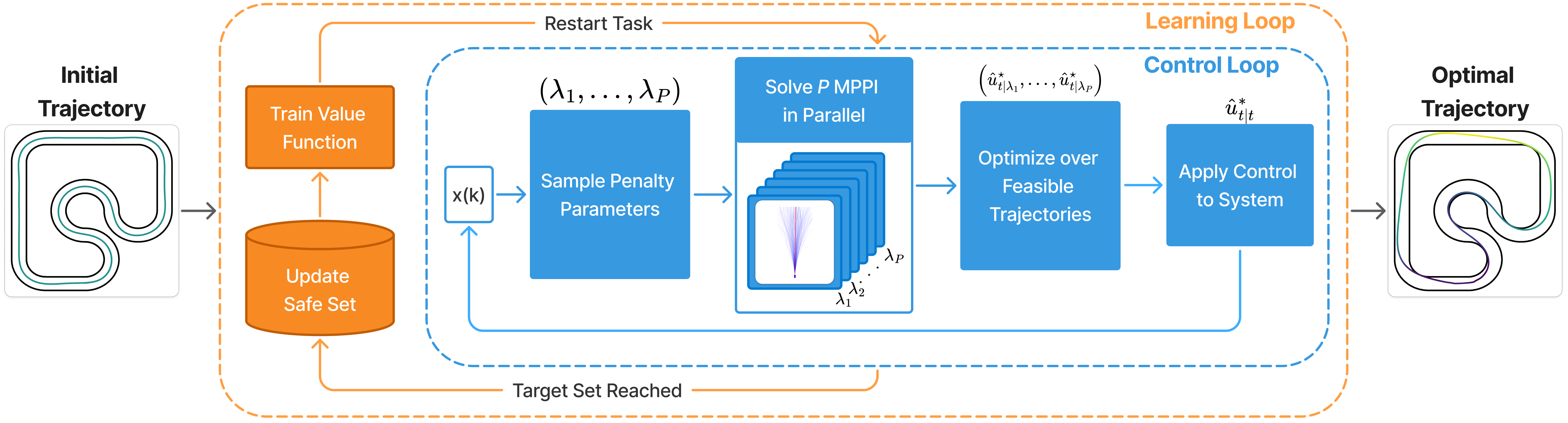
Safe Information-Theoretic Learning Model Predictive Control (SIT-LMPC) addresses a constrained infinite-horizon optimal control problem for discrete-time nonlinear stochastic systems. Trajectories from previous task executions are used to learn a value function with normalizing flows.
To solve the resulting stochastic receding-horizon optimal control problem, we use AP-MPPI, am information-theoretic model predictive control (MPC) framework that balances safety and optimality by online tuning of penalty parameters to enforce the constraints. The algorithm is designed for parallel execution on graphics processing units. Simulations and hardware experiments demonstrate iterative performance improvement while satisfying system constraints.
02 · Learning from failed executions
State-control invariance from failure data
Failure-Aware Iterative Learning (FAIL) computes the maximal state-control invariant set for deterministic linear time-invariant systems with unknown dynamics and polytopic constraints. This set encodes both the maximal control invariant state set and, at each state, the control inputs that preserve invariance.
FAIL uses regression on failing trajectories to learn predecessor halfspaces from one-step failing state-input pairs. These halfspaces update the constraints in the joint state-control space. We prove that the learned constraint set converges monotonically to the maximal state-control invariant set without knowledge of the system dynamics.
FAIL paper03 · Ongoing research
Reducing the number of failures
Learning from failures raises a further question: how many failed executions are required to identify the maximal state-control invariant set? My ongoing research investigates how to select informative executions to reduce this number.
A longer-term objective is to combine this constraint-learning approach with performance improvement from successful trajectories. Such an integration would allow a controller to use both types of execution data within a common iterative control framework.
04 · Autonomous vehicle applications
Online model learning and adaptive control
In autonomous vehicle applications, I study how online system identification can account for changing friction, nonplanar terrain, and model uncertainty. This work combines Gaussian process dynamics models with predictive control and includes ensemble models for driving across surfaces with different friction, recursive sparse models for nonplanar MPC, and adaptive differentiable control for racing.
I also develop control software and robotic platforms for evaluating these methods in simulation and on hardware.
Nonplanar MPC · Ensemble Gaussian processes · Adaptive differentiable MPCC
Publications
Papers & preprints
* Equal contribution. Google Scholar
2026
-
Failure-Aware Iterative Learning of State-Control Invariant Sets
IEEE Conference on Decision and Control, 2026.
-
AD-MPCC: Adaptive Differentiable Model Predictive Contouring Control for Autonomous Racing
IEEE/RSJ International Conference on Intelligent Robots and Systems, 2026.
-
STL-SVPIO: Signal Temporal Logic Guided Stein Variational Path Integral Optimization
IEEE/RSJ International Conference on Intelligent Robots and Systems, 2026.
-
Nonplanar Model Predictive Control for Autonomous Vehicles with Recursive Sparse Gaussian Process Dynamics
IEEE Intelligent Vehicles Symposium, pp. 2088–2093, 2026.
-
SIT-LMPC: Safe Information-Theoretic Learning Model Predictive Control for Iterative Tasks
IEEE Robotics and Automation Letters, 11(1), pp. 986–993, 2026.
2025
-
Zero-Shot Context Identification through Clustering and Foundation Modeling for Friction Estimation
ICRA Workshop on Foundation Models and Neuro-Symbolic AI for Robotics, 2025.
2024
-
PoseINN: Realtime Visual-based Pose Regression and Localization with Invertible Neural Networks
RoboNeRF — 1st Workshop on Neural Fields in Robotics, ICRA, 2024.
2023
-
Ensemble Gaussian Processes for Adaptive Autonomous Driving on Multi-friction Surfaces
IFAC World Congress · IFAC-PapersOnLine, 56(2), pp. 494–500, 2023.
-
Human-Robot Interaction using VAHR: Virtual Assistant, Human, and Robots in the Loop
IEEE International Conference on Robot and Human Interactive Communication, 2023.